How I Built a “Business Within the Business” and Turned Partnerships into Millions
I guess it’s fortunate that the older I get, age 68 as I write this, incidents happen that cause me to reflect on both my personal and professional life.
Because I am left-handed, I’ve always felt the rest of the world was backward; it certainly couldn’t have been me. Whatever the reason, it seemed that I always looked at things from different angles.
Today, that’s referred to as “reverse engineering,” apparently. Whatever its true title, as the future book states, It Worked For Me! Since around 1987, when I began my sales career, I have been enamored of building a business within a business.
Building a Business Inside Someone Else’s Company
In essence, while the rest of the company’s sales team was selling those standard goods the company supported, one by one, or even five at a time, I was busy building an army of an external third-party sales force consisting of third-party manufacturers’ external sales teams.
In essence, I was using the company’s business infrastructure as my own engine, their accounting, their warehousing, their marketing. My selling. A perfect fit for both of us.
In many ways, running the State of Texas State Contract while in Austin in 1980 solidified how to engage with those company employees outside the procurement department. I learned much from speaking directly with the sales employees in the field who had assigned territories by county. This enabled me to have direct, constant communication with the sales force, rather than hearing only from their customers.
Plus, I was meeting so many new contacts; outside sales representatives from other manufacturers, many of whom I became a customer of in order to add their products to my customer portfolio.
In no time, to them, I was a product expert (the bar was low). They would invite me to meet with them at a customer’s site. Most of these were state colleges, such as UT-Austin and Texas A&M. Those were easy. The six-hour drive from Austin to Lubbock? Not so much. The six-hour drive back was even worse.
Being customer-facing early in my career and talking about what the product could do helped me stand out from the competition. There would be no weak-ass salesperson undercutting me on price, without caring about their own profit margins. I did care. I was working too hard and challenging myself to sell goods and maintain an over-twenty-percent margin point. Any schmuck could sell on price and bring in single-digit margins. I was never that schmuck.
While the “alleged” competition was selling black-and-white, I was selling Technicolor, emphasizing the product’s value to that person’s business, its longevity, and its uptime. I rarely had this conversation with buyers, other than, of course, Sally Waller at State Farm Insurance. She was the buyer who got it. She realized that the best deal was rarely the best price.
For me, selling was all about horseshoes and hand grenades. I just had to be close. Close got me in. And once I got it, I was rarely out.
For the most part, everything went through them regardless. The agent or salesperson at that school or government agency made sure of it. I sold a lot of the products they carried. Brands like Okidata, Wyse, and IBM. I was fortunate to move to Austin with that contract already won. An instant-on button for me.
This relationship with the Texas schools was a tremendous learning curve for me. In no time, I was bringing in new vendors, especially vendors with a large salesforce. My purpose was to have them consider me as a one-stop shop to route their customers to buy that salesperson’s brand. The trust was critical to me. I knew all it took was one slip-up or one side-sell, and the news would be coast-to-coast via their sales reps before sundown.
In the meantime, we were capturing business throughout Texas. In this case, I learned my first two basic rules for sales success: Know Thy Customer and Know Thy Competition. The PC boom had just exploded. The timing could not be any better.
Why Knowing Your Customer and Competition Matters in Business
When large companies started to embrace the “PC fad,” I knew that their upper-echelon salesforce members’ egos would never allow them to “hawk PC’s.” It was beneath them and a fad, at best. Take Sperry Univac, for instance. In 1986, mainframe giant Sperry bought other mainframe giant, Burroughs, and became Unisys (United Systems).
Over those first two years, I had been selling Unisys PCs to their largest customers in the United States – from Fortune 500 companies to large industrial manufacturers. This all started at Tek-Aids Industries, where I first parachuted into the computer industry back in 1980.
Two companies later, after leaving Tek-Aids, when I landed at Elek-Tek, at the time the largest computer retail sales company in the United States, it was in their newly developed Corporate Division, selling to midwestern corporations, rather than retail end customers, which was what the company had been built on. This was all happening as the IBM PC2 was announced.
The Unisys PC Opportunity That Changed Everything
Through word-of-mouth from my Unisys friends, I learned that their company was planning to announce its own PC to sell to their mainframe customers, as they were all looking to PCs to connect to their mainframes. Naturally, Unisys wanted its brand name on the unit; it forged an OEM agreement with Goldstar (now known as LG Electronics) to make a Unisys-branded PC available to its $1B in mainframe customers.
There was one thing they had never planned on.
Their mainframe business sales force has zero intention of “lowering themselves” in front of the Chief Information Officer (CIO) customer to get him to purchase PCs. That’s where I came in. That certainly was not beneath me! I offered myself to the Unisys team, most of whom I knew and had worked with before. My business plan was to create a Unisys PC store within Elek-Tek. Seems like a no-brainer, right?
What I learned about a no-brainer is that the person on the other side of the conversation usually lacks the brainpower to understand the opportunity’s potential.
I remained steadfast and knew it would be successful. The company wanted me to guarantee success, and I would not do that. What I did tell them is that if we don’t do this, someone else will. I went through the pros and cons. It took some doing, but I was persistent enough to get their buy-in.
That buy-in caused the dam to burst wide open. We surpassed $4M in Unisys PC sales in that first full year and never looked back, well, until 1994, that is.
That’s another story for another day. It’s in my book, if you’re interested.
***
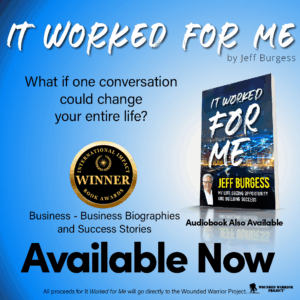
To learn about this entire journey, pick up a copy of 𝙄𝙩 𝙒𝙤𝙧𝙠𝙚𝙙 𝙁𝙤𝙧 𝙈𝙚: 𝙈𝙮 𝙇𝙞𝙛𝙚 𝙎𝙚𝙞𝙯𝙞𝙣𝙜 𝙊𝙥𝙥𝙤𝙧𝙩𝙪𝙣𝙞𝙩𝙮 𝙖𝙣𝙙 𝘽𝙪𝙞𝙡𝙙𝙞𝙣𝙜 𝙎𝙪𝙘𝙘𝙚𝙨𝙨 today! Also available now in audiobook format!
100% of all royalties go directly to the
Wounded Warrior Project!